

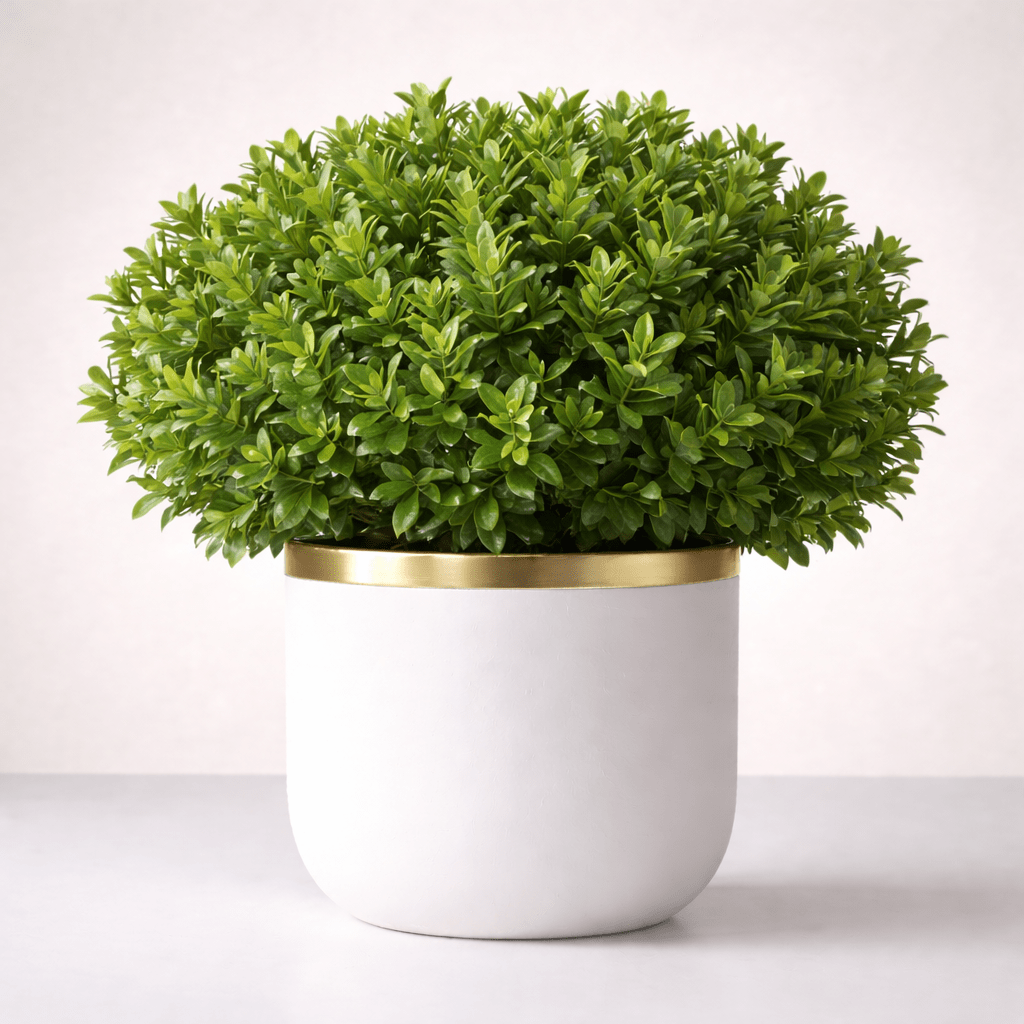
Boxwood Plant
₹399
In StockView & Listen Plant Education
Boxwood Plant - Video Guide
Watch Video
All Details
A classic and versatile evergreen shrub, renowned for its dense, small-leaved foliage and exceptional tolerance for pruning. It is a cornerstone of formal gardens, used for centuries to create precise hedges, topiaries, parterres, and low borders due to its neat, compact growth habit.
I am a slow to medium-growing, broadleaf evergreen shrub with a naturally rounded or mounded form.
My most distinctive feature is my small, oval, glossy leaves that grow densely on multi-branched stems, creating a fine texture.
My wood is very hard (giving me my name, "boxwood") and my leaves have a distinctive, somewhat pungent smell when crushed.
I produce inconspicuous, pale yellow flowers in spring that are mildly fragrant.
I am native to Europe, Asia, Africa, and Central America, with different species originating from different regions.
I prefer consistently moist, well-drained soil, especially when newly planted. Never let me dry out completely.
Once established, I have moderate drought tolerance, but prolonged dryness will cause stress and leaf bronzing.
I am highly intolerant of "wet feet" or waterlogged soil, which leads to root rot.
Deep, infrequent watering that soaks the root zone is better than frequent light sprinklings.
I grow best in full sun to partial shade.
In hot climates, I benefit from afternoon shade to prevent leaf scorch (bronzing).
I can tolerate fairly deep shade, but my growth will be more open and less dense.
I am a hardy shrub, with most common varieties thriving in USDA zones 5-8. Some varieties are suited to zones 4 or 9.
I prefer moderate temperatures and can struggle in the extreme heat of southern zones without shade and ample water.
Winter winds and sun can cause desiccation (bronzing or browning), so a protected site is beneficial.
I am primarily used for formal hedges, topiary, garden borders, and foundation plantings.
Plant in rich, well-drained, slightly acidic to neutral soil. Amend heavy clay soils.
For a hedge, space plants 1/2 to 2/3 of their mature width apart. Dig a trench, not just individual holes.
Apply a 2-3 inch layer of mulch around my base to retain moisture and keep roots cool, but keep it away from the trunk.
I am a light feeder. Apply a balanced, slow-release granular fertilizer in early spring before new growth begins.
Over-fertilizing, especially with high-nitrogen fertilizers, can cause excessive, weak growth and increase susceptibility to pests and diseases.
A soil test is the best guide for fertilizer needs.
Scientific Name: Buxus spp. (e.g., B. sempervirens [Common Boxwood], B. microphylla [Littleleaf Boxwood])
Common Names: Box, Boxwood
Plant Family: Buxaceae
Plant Type: Broadleaf evergreen shrub
All parts of me are toxic to dogs, cats, and horses. I contain alkaloids that can cause vomiting, diarrhea, seizures, and in rare cases, respiratory failure if ingested in large quantities.
As a dense, outdoor evergreen, I contribute to carbon sequestration, oxygen production, and can help filter particulates from the air. My role is primarily in the landscape ecosystem.
The premier plant for creating crisp, formal hedges and intricate topiary.
Provides year-round structure, color, and privacy in the garden.
Deer-resistant due to my bitter taste and alkaloids.
Can be sheared into virtually any shape.
Long-lived and durable when properly sited and cared for.
Boxwood Blight: A devastating fungal disease causing dark leaf spots, black streaking on stems, and rapid defoliation. Requires strict sanitation and may necessitate plant removal.
Root Rot (Phytophthora): Caused by poorly draining soil.
Winter Burn/Desiccation: Leaves turn orange, bronze, or brown from winter wind and sun.
Boxwood Leafminer: Larvae tunnel inside leaves, causing blisters and yellowing.
Boxwood Psyllid: Causes cupping of new leaves.
Volutella Blight: Causes pink spore masses on leaves and stem dieback.
I am a very long-lived shrub. With proper care and disease management, I can live and remain attractive for centuries. There are documented boxwood hedges in Europe that are over 300 years old. My growth is slow but steady, and I become more valuable and established with age. I am a true investment in the permanent structure of a garden.
Everyday: from 9:00AM to 7:00PM

H-1202, Sheladia Eris, Shela, Ahmedabad - 382465