

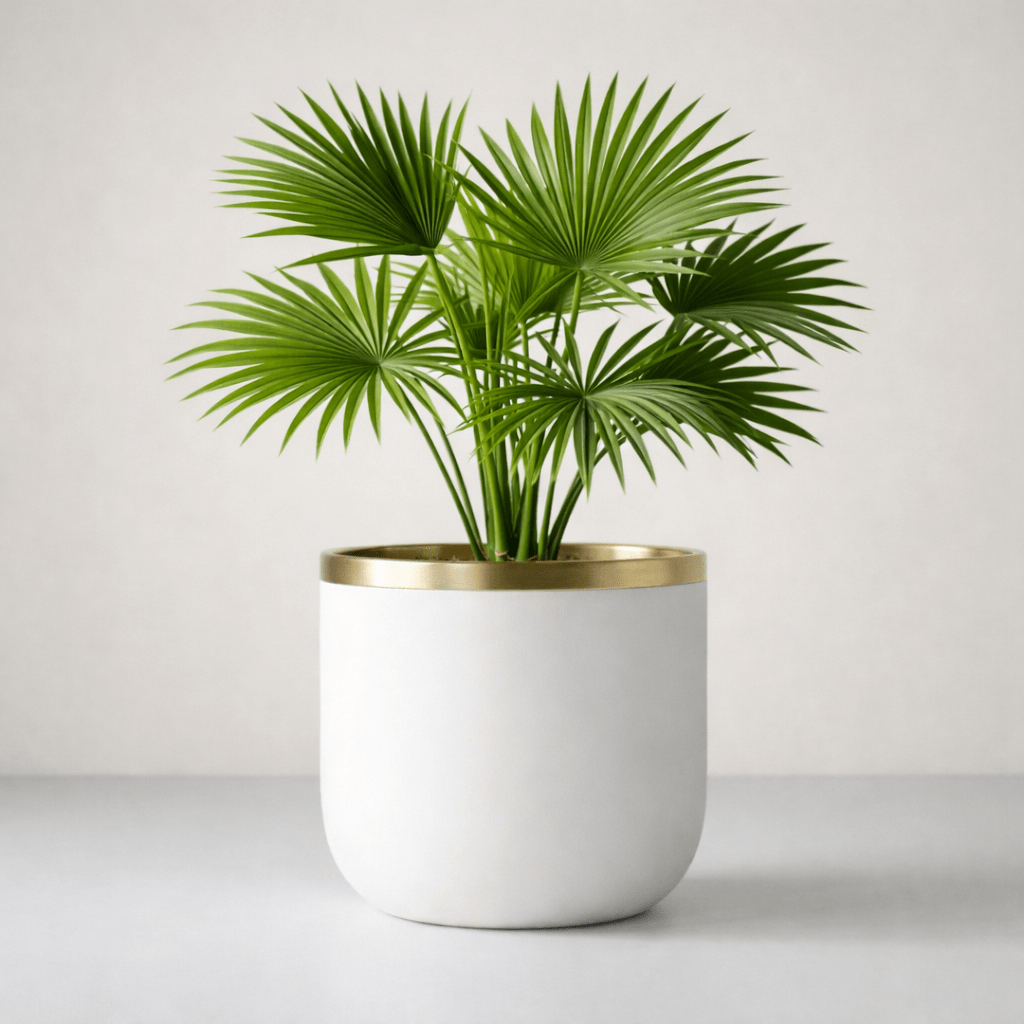
Livistona Palm Plant
₹499
In StockView & Listen Plant Education
Livistona Palm Plant - Video Guide
Watch Video
All Details
A stately and elegant genus of fan palms, renowned for their large, circular, glossy green leaves that split into numerous graceful, drooping segments. These palms are classic, hardy landscape trees that provide a lush, tropical canopy with a touch of old-world grandeur.
I am a solitary, single-trunked palm, known for my robust nature and relatively fast growth (for a palm) in favorable conditions.
My most distinctive feature is my large, nearly circular, costapalmate leaves—a blend of fan-shaped and slightly folded like a hand fan. The leaf segments are deeply split, and the tips often dangle elegantly. The petiole (leaf stem) is long and armed with sharp, curved spines along the margins.
As I mature, my trunk becomes tall, stout, and textured with distinctive, closely spaced leaf scar rings. In some species, old leaves persist, forming a characteristic "skirt" or "petticoat."
I am a common and beloved street and park tree in warm climates around the world.
I am native to a wide range across Asia, Australia, and the Pacific Islands, from Japan and Southern China through Southeast Asia to Australia.
I am moderately drought-tolerant once well-established but truly thrive with consistent moisture.
As a young palm, I require regular, deep watering to establish a strong, deep root system. Never let the root ball dry out completely.
Mature palms appreciate deep, thorough watering during dry spells. I am more tolerant of occasional wet feet than many desert palms but still require good drainage to prevent chronic soggy conditions.
Overwatering in poor-draining clay soil can lead to root rot.
I am highly adaptable but perform best in full sun to partial shade. I can tolerate full, hot sun once established.
Young plants benefit from some afternoon shade in extremely hot climates.
In too much shade, my growth will be slower, and the fronds will be less dense and may become elongated as they reach for light.
I thrive in warm, subtropical to tropical climates and am best suited to USDA zones 8b-11 (hardiness varies by species, e.g., Chinese Fan Palm L. chinensis is quite cold-hardy).
My ideal range is 18°C to 32°C.
I am known for good cold tolerance. Mature specimens of hardy species can withstand brief dips down to -8°C to -5°C with only leaf damage, protecting the vital growing point (spear).
I am a classic landscape palm for avenues, gardens, parks, and as a standalone specimen. Give me plenty of space for my wide-spreading canopy (mature height 10-25m, depending on species).
Plant in deep, fertile, and moist but well-draining soil. I am adaptable to a range of soil types, including clay, if drainage is adequate.
Water deeply and regularly for the first 1-2 years until established. Apply a thick mulch ring to retain moisture and protect roots.
Wear heavy gloves when handling due to the sharp spines on the leaf stems (petioles).
I am a moderate to heavy feeder to support my robust growth and large leaves.
Fertilize 2-3 times per year during the growing season (spring to early fall) with a slow-release, palm-specific fertilizer that contains micronutrients (especially manganese and magnesium).
Yellowing fronds can indicate a nutrient deficiency, commonly potassium (K) or magnesium (Mg).
Scientific Name: Livistona spp. (e.g., L. chinensis, L. australis, L. rotundifolia, L. saribus)
Common Names: Chinese Fan Palm, Australian Fountain Palm, Footstool Palm, Saribus Palm (species-dependent)
Plant Family: Arecaceae (Palm family)
Plant Type: Solitary, evergreen flowering palm tree
My long, sharply spined petioles (leaf stems) pose a significant risk of puncture wounds and lacerations to pets and people. The plant material is not considered highly toxic, but ingestion of large amounts may cause mild gastrointestinal upset due to fiber and possible irritants.
As a large outdoor tree, I am a powerhouse for carbon sequestration, oxygen production, and providing cooling shade—key for urban heat island mitigation. My role is not measured for indoor air purification.
Provides a grand, classic palm aesthetic with a lush, full canopy.
Relatively fast-growing and hardy for a palm, tolerating a range of conditions.
Excellent shade tree and habitat for birds.
Highly resistant to pests, deer, and, once established, drought.
Leaf Spot Fungi: Can occur in humid, wet conditions or with overhead watering. Appears as small brown or black spots on leaves.
Nutrient Deficiencies: Potassium deficiency causes translucent yellow-orange spotting on older leaves; magnesium deficiency causes broad yellow bands along leaf edges.
Ganoderma Butt Rot: A serious fungal disease that causes conks (mushrooms) to form at the trunk base and leads to internal decay and decline. There is no cure.
Scale Insects & Palm Aphids: Can cluster on the undersides of fronds or on flower stalks.
Petiole/Spine Injuries: The sharp spines are a hazard during pruning and maintenance.
I am a long-lived perennial tree with a lifespan of several decades to over a century under ideal conditions. I grow steadily from a seedling, forming a trunk and developing my signature canopy. I flower annually, producing large panicles of small cream or yellow flowers that develop into small, glossy fruits. My life is one of steady, graceful growth, providing enduring structure and beauty to the landscape.
Everyday: from 9:00AM to 7:00PM

H-1202, Sheladia Eris, Shela, Ahmedabad - 382465