

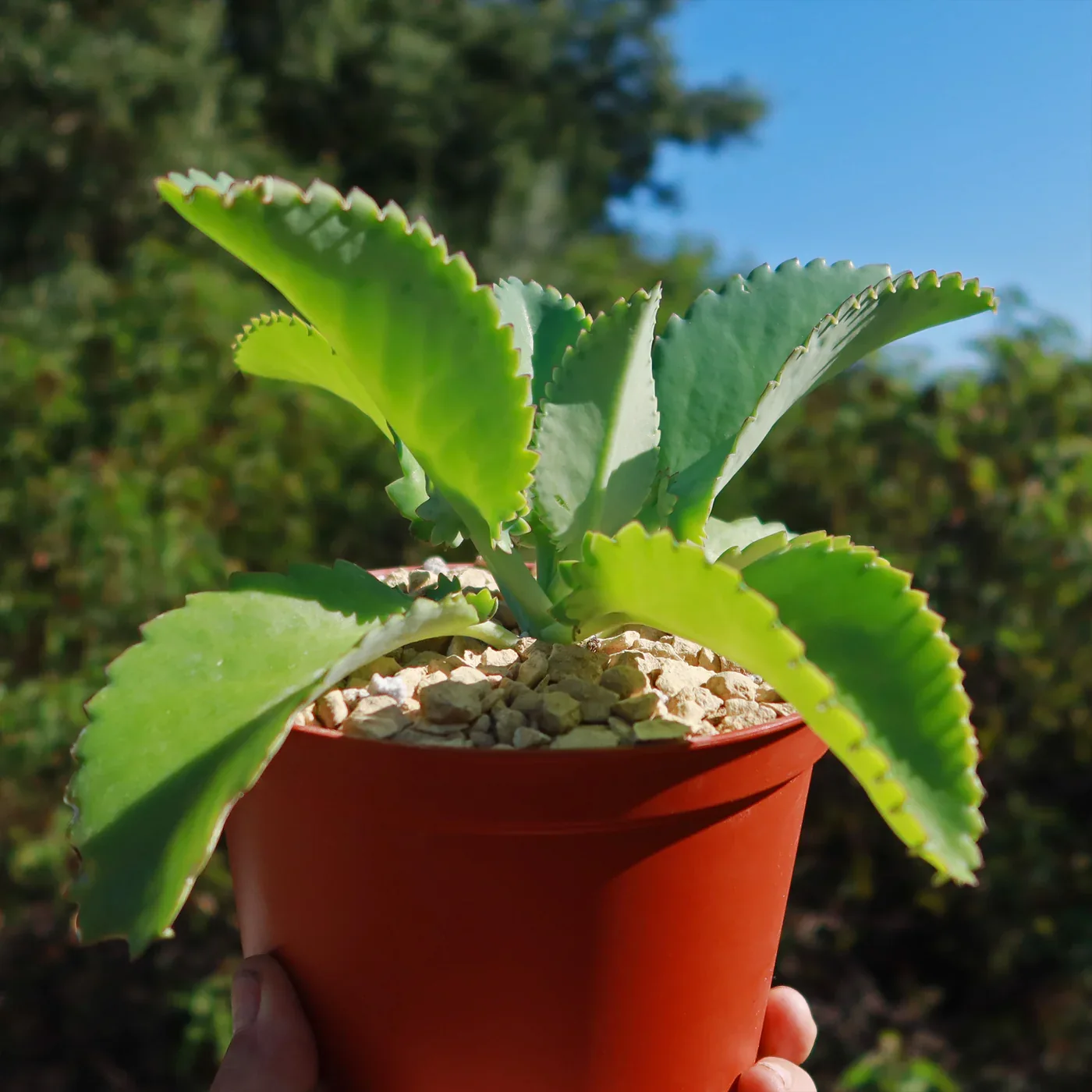
Mother Of Thousands Plant
₹199
In StockView & Listen Plant Education
Mother Of Thousands Plant - Video Guide
Watch Video
All Details
A fascinating, prolific, and somewhat alien-looking succulent. True to its name, it is a relentless producer of countless tiny plantlets along the edges of its leaves, creating a textured, cascading effect. A study in botanical self-propagation.
I am a succulent, upright-growing perennial or biennial with a single, thick, unbranched stem.
My most distinctive feature is the numerous, tiny, complete plantlets (propagules) that form along the scalloped edges of my long, lance-shaped, blue-green leaves. These plantlets develop roots while still attached.
I am a viviparous plant, meaning I give "live birth" – the plantlets drop off and root readily wherever they land, leading to my other common name, "Mother of Millions."
I produce clusters of small, tubular, grayish-pink to coral-colored flowers on tall stalks at the end of my life cycle (monocarpic).
I am native to the Fiherenana River valley and plateaux in southwestern Madagascar. I have become naturalized in many tropical and subtropical regions, often invasively.
I am drought-tolerant but appreciate more regular water than some succulents during active growth.
Use the "soak and dry" method: water deeply when the soil is completely dry, then allow it to dry out thoroughly again.
I am susceptible to overwatering and root rot. Ensure perfect drainage. Reduce watering significantly in winter when growth slows.
The fleshy leaves store water, so when in doubt, it's safer to under-water.
I require plenty of bright, direct light to maintain compact growth and vibrant leaf color.
A south or west-facing window is ideal. With insufficient light, I become leggy, pale, and weak, and the stem may topple over.
I can tolerate full sun outdoors but may need acclimation to prevent sunburn.
I thrive in warm temperatures and am best suited to USDA zones 9b-11 outdoors.
My ideal range is 18°C to 27°C. I am not frost-tolerant.
Keep me above 10°C at all times. Cold, wet soil is fatal.
I am best suited as a potted plant due to my prolific, often invasive, spreading habit via plantlets.
Use a very well-draining cactus/succulent potting mix, amended with extra perlite or pumice.
Choose a pot with excellent drainage holes. I am a good candidate for containers where my "babies" can be easily managed.
Warning: Plant me with caution outdoors in frost-free climates, as I can escape cultivation and crowd out native plants.
I am a light to moderate feeder during the growing season (spring and summer).
Fertilize monthly with a balanced, diluted liquid fertilizer or a formula for cacti/succulents.
Do not fertilize in fall and winter.
Scientific Name: Kalanchoe daigremontiana (syn. Bryophyllum daigremontianum)
Common Names: Devil's Backbone, Alligator Plant, Mexican Hat Plant
Plant Family: Crassulaceae
Plant Type: Monocarpic perennial succulent
I contain cardiac glycosides (bufadienolides) which are toxic to cats, dogs, livestock, and humans. Ingestion can cause vomiting, diarrhea, abnormal heart rhythm, and, in severe cases, seizures or death. The plantlets are especially tempting to curious pets. Keep me completely out of reach.
Like most succulents, my small size limits any significant air purification impact. My primary role is ornamental, albeit with a cautionary note.
An endlessly fascinating plant for learning about propagation and plant life cycles.
Extremely easy to propagate—you'll never run out of new plants.
Architectural form with interesting textural details.
Pest-resistant due to toxic compounds.
Leggy, Etiolated Growth: Caused by insufficient light. The main stem becomes weak and may collapse.
Root and Stem Rot: Caused by overwatering or poor drainage.
Mealybugs: Can infest the stem and leaf axils, especially in lower-light, indoor conditions.
Invasive Spread: The #1 problem in suitable climates. Plantlets will colonize nearby pots and garden beds relentlessly.
Monocarpic Death: After flowering, the main plant dies, but is usually surrounded by its own offspring.
My lifecycle is defined by my monocarpic nature. I typically live for 2-3 years as a vegetative plant, growing taller and producing plantlets. When mature, I send up a tall flower stalk, blooms, sets seed, and then the main plant dies. However, my life is perpetuated endlessly by the hundreds of plantlets I produce, each capable of starting a new colony. My life is a cycle of prolific rebirth.
Everyday: from 9:00AM to 7:00PM

H-1202, Sheladia Eris, Shela, Ahmedabad - 382465