

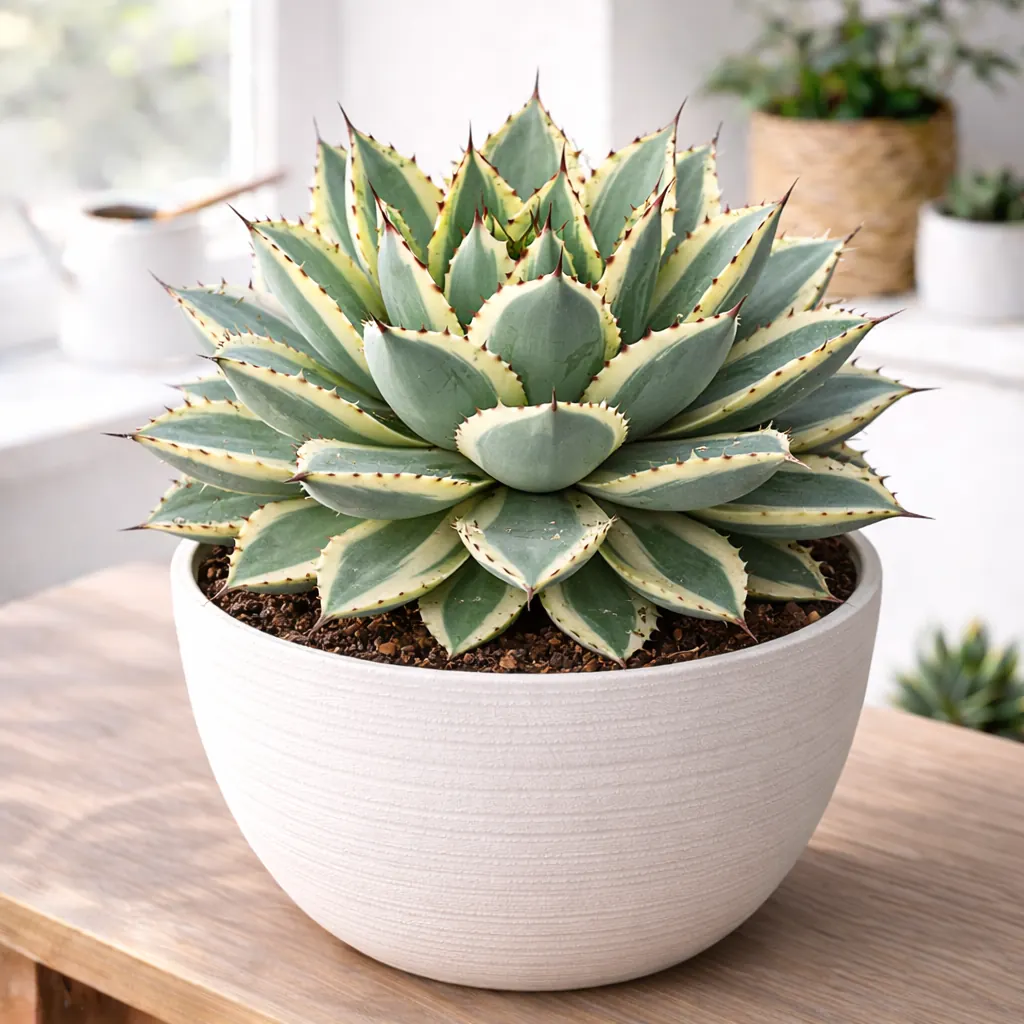
Butterfly Agave Plant
₹499
In StockView & Listen Plant Education

Butterfly Agave Plant - Video Guide
Watch Video
All Details
A stunning and compact succulent, renowned for its symmetrical rosette of fleshy, spoon-shaped leaves with dramatic white markings along the edges. Its elegant, variegated form resembles a stylized butterfly or artichoke, making it a highly prized specimen for containers, rock gardens, and xeriscapes.
I am a small, stemless, slow-growing succulent that forms a perfect, solitary rosette.
My most distinctive feature is my thick, smooth, pale green to blue-green leaves that are adorned with crisp, bright white or creamy-yellow markings along the margins. These markings are often raised, adding a textured look.
My leaves are broad, rounded at the tips, and have a gentle, spoon-like curve. The leaf margins are smooth, lacking teeth or spines.
I am monocarpic, meaning I will flower once at the end of my life, sending up a tall flower spike before dying.
I am native to the rocky, arid regions of Mexico.
I am highly drought-tolerant. My water needs are very low.
Use the "soak and dry" method thoroughly. Water deeply only when the soil is completely dry.
In winter, water extremely sparingly—once a month or less—to prevent rot during dormancy.
I am extremely susceptible to root and crown rot from overwatering. Perfect drainage is critical. Avoid getting water in the center of the rosette.
I am a full sun to partial sun lover. I need several hours of direct sunlight daily to maintain my compact form and vibrant white variegation.
In hot climates, I appreciate light afternoon shade to prevent sun stress.
Too much shade will cause my rosette to become loose and open, and the white markings may fade or become less distinct.
A south or east-facing exposure is ideal.
I thrive in warm, arid climates and am best suited to USDA zones 9-11 if grown outdoors.
My ideal range is 18°C to 29°C.
I am sensitive to frost and prolonged wet, cold conditions. Protect me from temperatures below -2°C.
I am a premier specimen for containers, succulent dish gardens, rockeries, and dry borders. My size and beauty make me perfect for focal points.
Plant me in extremely well-draining, gritty soil. A cactus/succulent mix amended with extra pumice or perlite is essential.
Use a shallow, wide pot with excellent drainage holes. My root system is relatively small.
Handle with care to preserve the powdery coating (farina) and delicate leaf margins. Avoid touching the leaves excessively.
I am a very light feeder. Fertilizing is rarely necessary.
If desired, apply a diluted, low-nitrogen cactus/succulent fertilizer once in early spring.
Over-fertilizing can cause soft, weak growth and may dilute the beautiful leaf variegation.
Scientific Name: Agave potatorum 'Kichiokan' or Agave isthmensis (often sold as 'Butterfly Agave'). There is some taxonomic variation in the trade.
Common Names: Butterfly Agave, Duke's Agave, Verschaffelt Agave
Plant Family: Asparagaceae
Plant Type: Monocarpic perennial succulent
While my leaf margins are smooth, the sap can be a skin irritant. If ingested by pets, the saponins I contain can cause gastrointestinal upset (vomiting, diarrhea). The primary risk is often physical irritation from the sap.
Minimal. I am grown for my exceptional ornamental value, not for air purification.
Provides a perfectly symmetrical, variegated form that is a living sculpture.
Extremely low-maintenance and water-wise.
Stays a manageable size, ideal for pots and small spaces.
Highly resistant to pests and deer.
Root/Crown Rot: The #1 killer, caused by overwatering or poor drainage.
Sunburn: Brown or bleached spots on leaves from being suddenly moved into intense, direct sun without acclimation.
Fungal Leaf Spot: Can occur in humid conditions or from overhead watering.
Mealybugs & Scale: Can infest the tight spaces at the base of leaves.
Loss of Variegation/Stretching: Caused by insufficient light.
I am a slow-growing, monocarpic perennial. I will live for many years (typically 10-15 years or more) as a vegetative rosette. When I reach maturity, I will send up a tall, dramatic flower spike, bloom, set seed, and then die. However, I often produce offsets (pups) around my base before flowering, which can be separated and grown on to continue the lineage. Therefore, a colony of Butterfly Agaves can be maintained indefinitely. My beauty is a patient gardener's reward.
Everyday: from 9:00AM to 7:00PM

H-1202, Sheladia Eris, Shela, Ahmedabad - 382465