

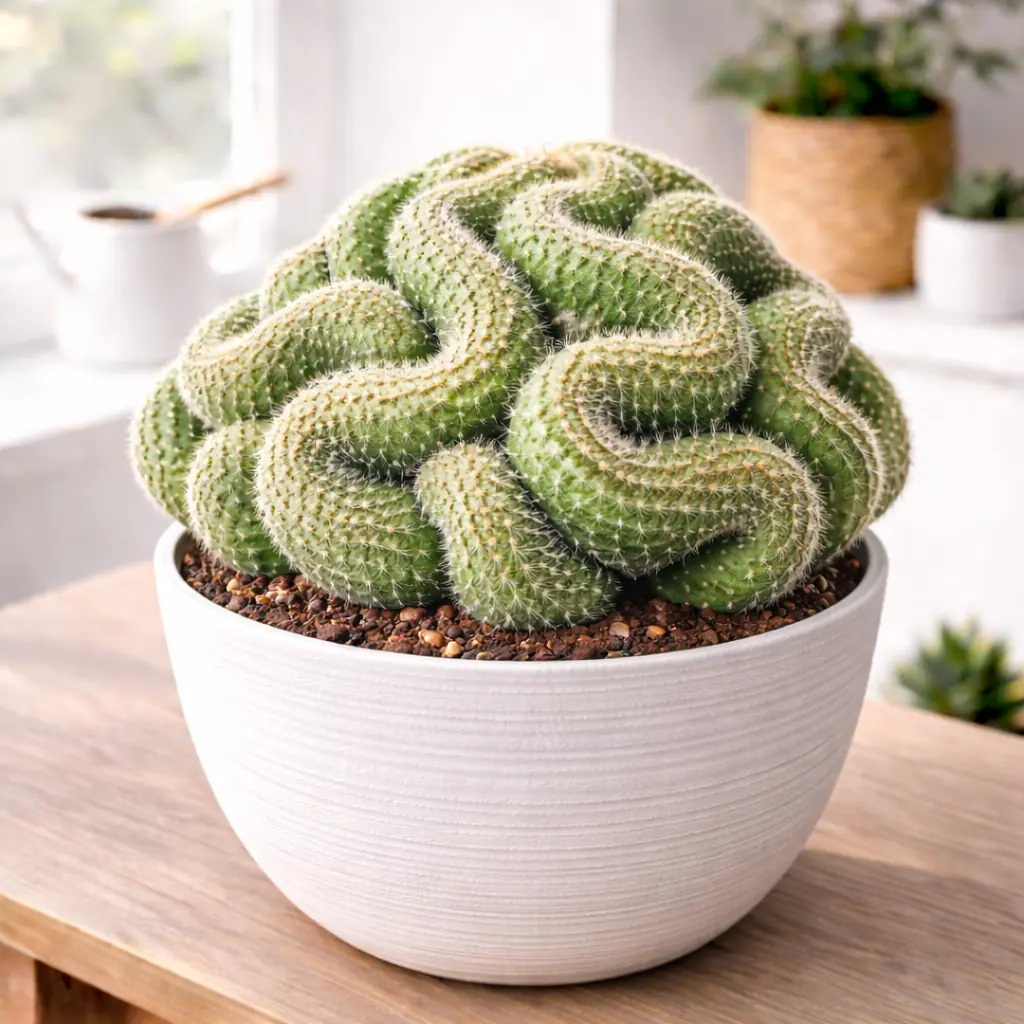
Brain Cactus Plant
₹399
In StockView & Listen Plant Education

Brain Cactus Plant - Video Guide
Watch Video
All Details
A bizarre and fascinating succulent that lives up to its name, featuring tightly packed, convoluted ridges that eerily resemble the folds of a mammalian brain. This slow-growing, sculptural oddity is a prized specimen for collectors of the unusual.
I am a small, globular to short-cylindrical cactus that grows as a solitary stem or slowly clusters.
My most distinctive feature is my intricately lobed, twisted, and furrowed stem surface that forms a continuous pattern of gray-green to bluish-green, brain-like convolutions. I have no true ribs.
I am almost completely obscured by a dense covering of tiny, short, white or yellowish spines that emerge from the areoles along the crests of the folds, giving me a fuzzy, sometimes golden appearance.
My odd form is a natural mutation (a cristate or monstrose form) that has been stabilized in cultivation.
I am a cultivated form, but my base species (Mammillaria elongata) is native to central Mexico.
I am a true cactus and highly drought-tolerant. My water needs are minimal.
Use the "soak and dry" method meticulously. Water deeply only when the soil is completely dry all the way through. In summer, this may be every 2-4 weeks; in winter, it may be once a month or less.
Overwatering is the #1 killer. My convoluted shape can trap moisture and is prone to rot at the base or within the folds. Excellent drainage and airflow are critical.
In winter, keep me almost completely dry to encourage health and potential flowering.
I require abundant bright, direct light to maintain a compact, healthy form and to encourage flowering.
A south or west-facing windowsill is ideal. Under insufficient light, I may become etiolated (stretched) and lose my dense, characteristic shape.
I can tolerate full sun but may need gradual acclimation to prevent sunburn, which appears as bleached or brown scarring.
I thrive in warm temperatures and am best suited to USDA zones 9b-11 if outdoors.
My ideal growing range is 18°C to 29°C.
I need a cool, dry winter rest period (around 10°C-15°C) to stimulate flowering. I am not frost-hardy; protect from temperatures below 5°C.
I am a perfect potted specimen for windowsills, shelves, and dish gardens. My small size and slow growth make me ideal for containers.
Drainage is paramount. Use a gritty, well-draining cactus/succulent mix (amend with 50%+ pumice or perlite).
Choose a shallow, unglazed terracotta pot with a drainage hole; the porous material helps wick away moisture.
Take care when handling due to the dense, tiny spines. Use folded paper, foam, or specialized tongs.
I am an exceptionally light feeder.
Fertilize only during the active growing season (spring to summer) with a low-nitrogen, cactus-specific fertilizer diluted to half-strength, once at most.
Over-fertilizing can cause weak, unnatural growth and split the skin. Less is always more.
Scientific Name: Mammillaria elongata f. cristata (Crested form)
Common Names: Brain Cactus, Crested Golden Stars
Plant Family: Cactaceae
Plant Type: Perennial, cristate (crested) succulent cactus
They can easily detach and embed in skin or pet noses/mouths, causing pain, irritation, and potential infection. While not systemically toxic, the physical danger is the primary concern. Keep me out of reach of curious pets.
My tiny size and slow metabolism mean I have no measurable impact on indoor air quality. I am purely a decorative and botanical curiosity.
A unique, living sculpture and a stunning conversation piece.
Extremely low-maintenance when proper dry conditions are provided.
Can produce charming, small, pink or white flowers in a ring around the crown in spring, though flowering is less common in crested forms.
Pest-resistant due to its spines.
Root and Stem Rot: Caused by overwatering, poor drainage, or water sitting in the folds. The plant will feel mushy at the base.
Etiolation (Stretching): Appears as thinner, paler, elongated growth stretching toward light. This ruins the brain-like form.
Sunburn: Appears as permanent white or brown, scarred patches from too-intense, sudden direct sun.
Mealybugs: Can hide in the tight crevices between the folds. Look for white, cottony masses.
Scale Insects: Can attach to the stems, appearing as small, brown, bumpy discs.
I am a very slow-growing, long-lived perennial. My crested form may grow only a few centimeters per year. I can live for decades with proper care. My lifecycle is one of gradual, sculptural expansion rather than a typical growth pattern. I may never flower, or may produce flowers sporadically, but my value is in my enduring, bizarre form.
Everyday: from 9:00AM to 7:00PM

H-1202, Sheladia Eris, Shela, Ahmedabad - 382465