

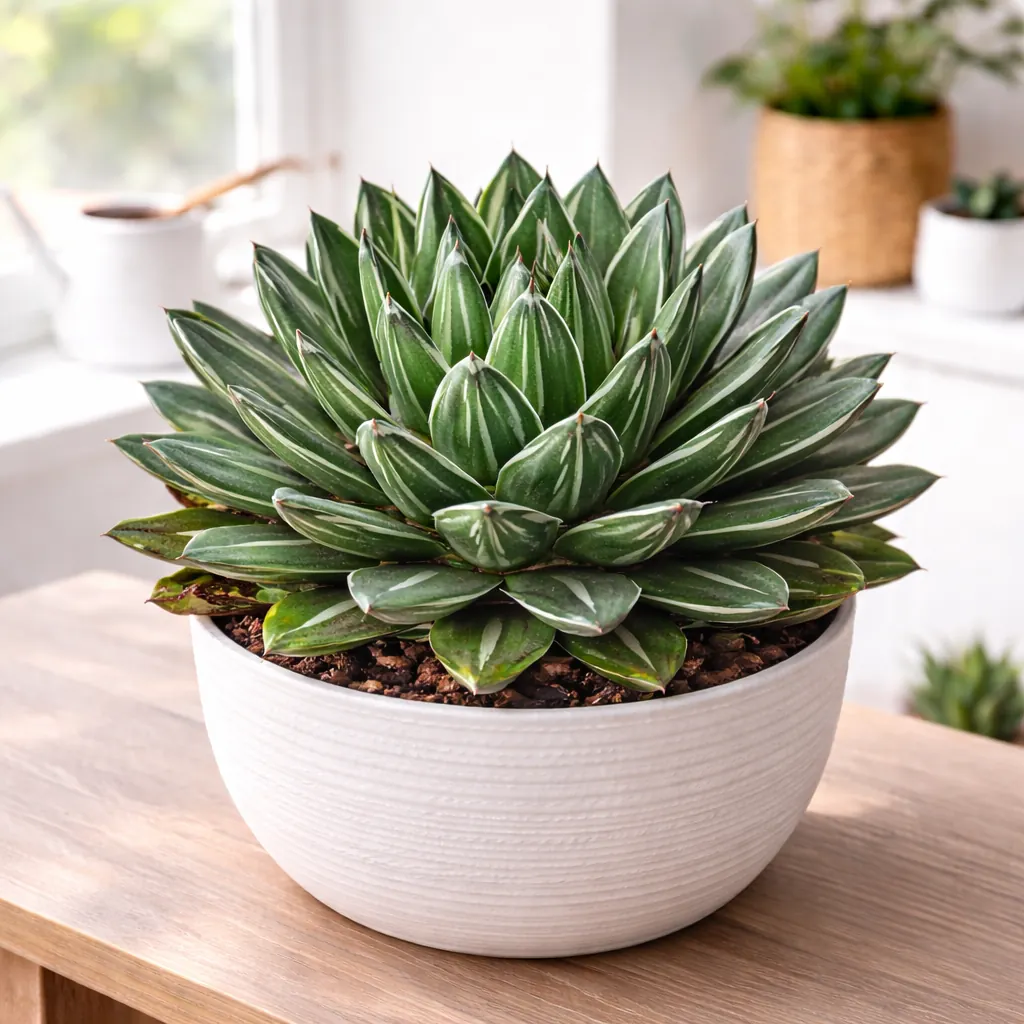
Queen Victoria Agave Plant
₹999
In StockView & Listen Plant Education

Queen Victoria Agave Plant - Video Guide
Watch Video
All Details
A regal and sculptural succulent, renowned for its perfectly symmetrical, compact rosette of thick, dagger-like leaves. It is a slow-growing, striking specimen plant prized for its geometric beauty and formidable presence in rock gardens, desert landscapes, and containers.
I am a small, stemless agave that forms a stunning, solitary, spherical rosette.
My most distinctive feature is my rigid, dark green to blackish-green leaves, each tipped with a sharp, terminal spine and edged with fine, white, decorative markings. My leaf margins are smooth, lacking the teeth common in other agaves.
My form is exceptionally geometric and symmetrical, often compared to a living artichoke or a precisely arranged art piece.
I am monocarpic, meaning I flower once at the end of my life, sending up a towering flower spike.
I am native to the Chihuahuan Desert in northeastern Mexico.
I am an extremely drought-tolerant desert plant. My water needs are very low.
Use the "soak and dry" method thoroughly. Water deeply only when the soil is completely dry, and then allow it to dry out completely again.
In winter, I require even less water, sometimes none at all if planted in the ground in a dry climate.
I am highly susceptible to root rot from overwatering. Excellent drainage is more critical than frequency of watering.
I am a full sun worshipper. I require at least 6-8 hours of direct, unfiltered sunlight daily to maintain my tight, compact shape and dark leaf color.
I can tolerate very light afternoon shade in extremely hot climates, but too much shade will cause my rosette to become loose, stretched, and pale.
I am ideal for south-facing exposures.
I thrive in hot, arid climates and am best suited to USDA zones 8-11. I am more cold-hardy than many agaves.
My ideal temperature range is between 18°C and 32°C.
I can tolerate occasional, brief dips down to -7°C if the soil is perfectly dry, but prolonged frost or wet cold is fatal.
I am a premier specimen for xeriscapes, rock gardens, modern landscapes, and striking container plantings.
Plant me in extremely well-draining, gritty soil (cactus/succulent mix amended with pumice or coarse sand).
In containers, use a pot with ample drainage holes, preferably unglazed terracotta.
Handle with extreme care due to my sharp terminal spine. Plant me away from footpaths and play areas.
I am an exceptionally light feeder. Feeding is rarely necessary.
If desired, apply a diluted, low-nitrogen cactus/succulent fertilizer once in early spring. Over-fertilizing will cause weak, floppy growth.
Scientific Name: Agave victoriae-reginae
Common Names: Queen Victoria Agave, Royal Agave
Plant Family: Asparagaceae
Plant Type: Monocarpic perennial succulent
While not considered highly toxic if ingested, my sharp terminal spine and rigid leaf tips pose a significant puncture and laceration risk to curious pets and people. The sap may also cause skin irritation.
Like most succulents, my air purification capacity is modest due to slow growth and small leaf surface area relative to larger plants. My primary benefit is ornamental.
Provides unparalleled, architectural symmetry and year-round visual interest.
Extremely low-maintenance and water-wise, perfect for sustainable landscaping.
Highly resistant to pests, deer, and rabbits.
An excellent long-term container plant due to its slow growth and compact size.
Root Rot: The #1 killer, caused by overwatering or poorly draining soil.
Etiolation (Stretching): Caused by insufficient sunlight, ruining my compact form.
Fungal Leaf Spot: Can occur if water sits in the crown or on leaves, especially in humid climates.
Agave Snout Weevil: A serious pest that can bore into the core, causing collapse. Monitor the base of the plant.
I am a very slow-growing agave with a long life. I typically live for 10 to 30 years before reaching maturity. At the end of my life, I will produce a magnificent, towering flower spike (up to 15 feet tall) with cream-colored flowers, set seed, and then die (monocarpic). My perfect symmetry is a patient gardener's reward.
Everyday: from 9:00AM to 7:00PM

H-1202, Sheladia Eris, Shela, Ahmedabad - 382465